
Dali is one of the most popular spots for China travelers and hugely popular with those working, teaching and studying in China. Forty minutes by plane or four to five hours by bus from Kunming, Dali is the perfect place to relax.
Dali is the capital city of the Dali Prefecture. It consists of Dali New City (Xiàguān) and Dali Old Town (Gǔchéng) and 11 other cities, among which are Weishan, Yangbi, Yuanlong, and Yongpin. The Old Town has a population of 40,000 and the entire Dali Prefecture around three million people and an area over 10,000 sq km.
With the beautiful Cangshan Mountains a short distance west of Dali Old Town and Erhai Lake a few kilometers to the east, it has a perfect natural setting. The climate is temperate with moderate summers and mild winters, though it can get rather windy in autumn and winter.
Nature
Changsan Mountains
The mountains are a national level Geopark and Nature Reserve and have much to offer to plant, bird, flower and hiking enthusiasts. Normally you'll take one of the chairlifts up the mountains and hike about 3-5 hours to the other chairlift to go down again.
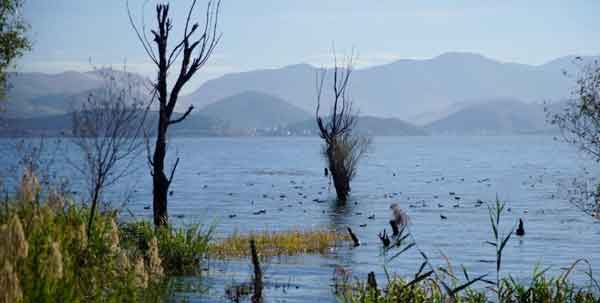
Erhai Lake
Visit the Guanyin Temple and several islands in the Erhai Lake. Go with a group and enjoy a great day out. Boats can easily be arranged in towns near the lake, as the owners come into the town to drum up business. You can see what you get from the photo books they carry.
Cloud Traveller's Path
The Cloud Traveller's Path is an extremely well-built path and in a better condition than many sidewalks in Chinese cities. It's supposed to be at an altitude of 2500m. Most signs along the way are both in Chinese and English. There are chairlifts at Zhonghe - which is an old Daoist temple and well worth a visit - and near the Gantong Temple. The 11 km route will take about 4 to 5 hours walking. The mountains are home to beautiful wild camellias, orchids, rhododendrons, azaleas, and abundant birdlife. The prefecture Dali is home to some of the rarest camellias in China and Cangshan is the source of most of these.
Most of the lower slopes are covered in replanted pine forests, while the higher slopes and steep valleys show a more natural forest cover.
Butterfly Spring
Nowadays, this holy place for Bai people is overwhelmed with Chinese tourists. It is said that this place is the source of the Erhai Lake. It is called 'Butterfly Spring' since there are uncountable butterflies.
Chicken Foot Mountain
Jizu Mountain, or Chicken Foot Mountain, is situated behind the village Wase on the east side of the Erhai Lake. The mountain and its range look like a chicken's foot. Actually, the area is worth a 2- to 3-day trip.
The top of the mountain and its slopes are covered with temples, many of which are desperately in need of reparation. Some temples have been restored and monks reside them. Be prepared: it is a difficult hike to the top of Chicken Foot Mountain (3200 m). But, you can go partly by horse and a cable car starts halfway up the slope.
Culture
Markets
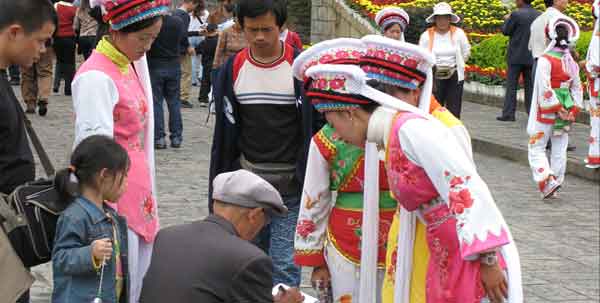
Markets are always nice to visit; the sea of colors accomplished by the smell of herbs and tea and shopping locals.
Most markets are held according to the lunar calendar. Some markets rotate between villages. When you like to visit a market, ask us to organize a tour according to your wishes.
Examples of markets around Dali:
- The market in Shaping is every Monday morning
- Xizhuo has a market every morning
- The market Shanba is held on Wednesdays. A lot of livestock is present
- Yousuo and Shaxi have Friday markets
- On Tuesdays, you can go to the market in Guanping
Wase - east side of the Erhai Lake
Every five days - thus on the 5th, 10th, 15th, etc - there is a market in Wase, on the eastern shore of the lake. Wase is a traditional and conservative Bai village. The market offers an interesting insight into the lives of people in a quiet country village.
Besides the market, you can visit a small tofu factory and an ancient courtyard house in Wase. The courtyard houses are different from those on the west side of the lake. But, you need to be introduced to get access to the courtyard houses. We can be of assistance.
Shaping Market
Situated about 30km north of Dali, you find the small town Shaping. It offers a lively weekly Monday morning market with plenty of local colors. The market starts early.
Visiting the market in Shaping is a great opportunity to meet local farmers and witness lively horse trading.
There is not much to buy - unless you are a farmer of course - but you can experience the feeling of living in a small country town.
Tang Dynasty Three Pagodas
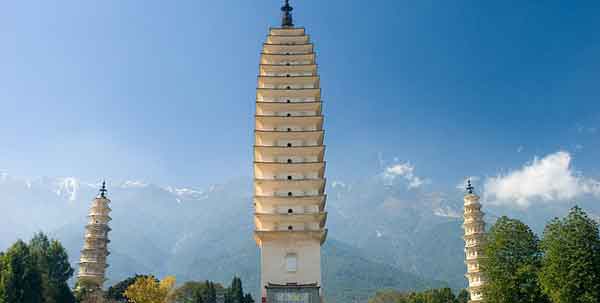
If you stay in Dali's Old Town, the Tang Dynasty Three Pagodas is just 10 minutes by bike to the northwest. You find them next door to the Three Pagodas Hotel. It is worth a visit because of the Tang architecture, the numerous statues of Buddha and Guanyin with influences from both India and China, the dragon fountains, and the two small museums.
The Three Pagodas is one of the best preserved Buddhist structures in China. The Central Pagoda is almost 1200 years old and represents a period in which Dali was the Buddhist Kingdom. However, the compounds behind the pagodas were destroyed in the 1920s earthquake and later in the Cultural Revolution.
It is a massive complex that continues far up the mountain. A climb up the mountains is rewarding; it offers a beautiful view over Dali's Old Town and Erhai Lake.
Qing Dynasty houses
Xizhou has almost 200 private houses registered on the national heritage list. These houses date from the Qing Dynasty. They are one of the best examples of traditional Qing architecture in China and are exquisitely detailed.
Building craftsmen from Xizhou were famous throughout Southeast Asia and traveled to Vietnam, Myanmar and throughout Southwest China to build and decorate houses. After they made their fortune, they returned to Xizhou to construct their own 'palace'.
Knock with us on these doors, and most doors will open for you to see the interesting architecture.